
Campus News
April 21st, 2026
Garrett College NRWT students discuss AMD
Acid Mine Drainage subject of environmental tech monitoring project
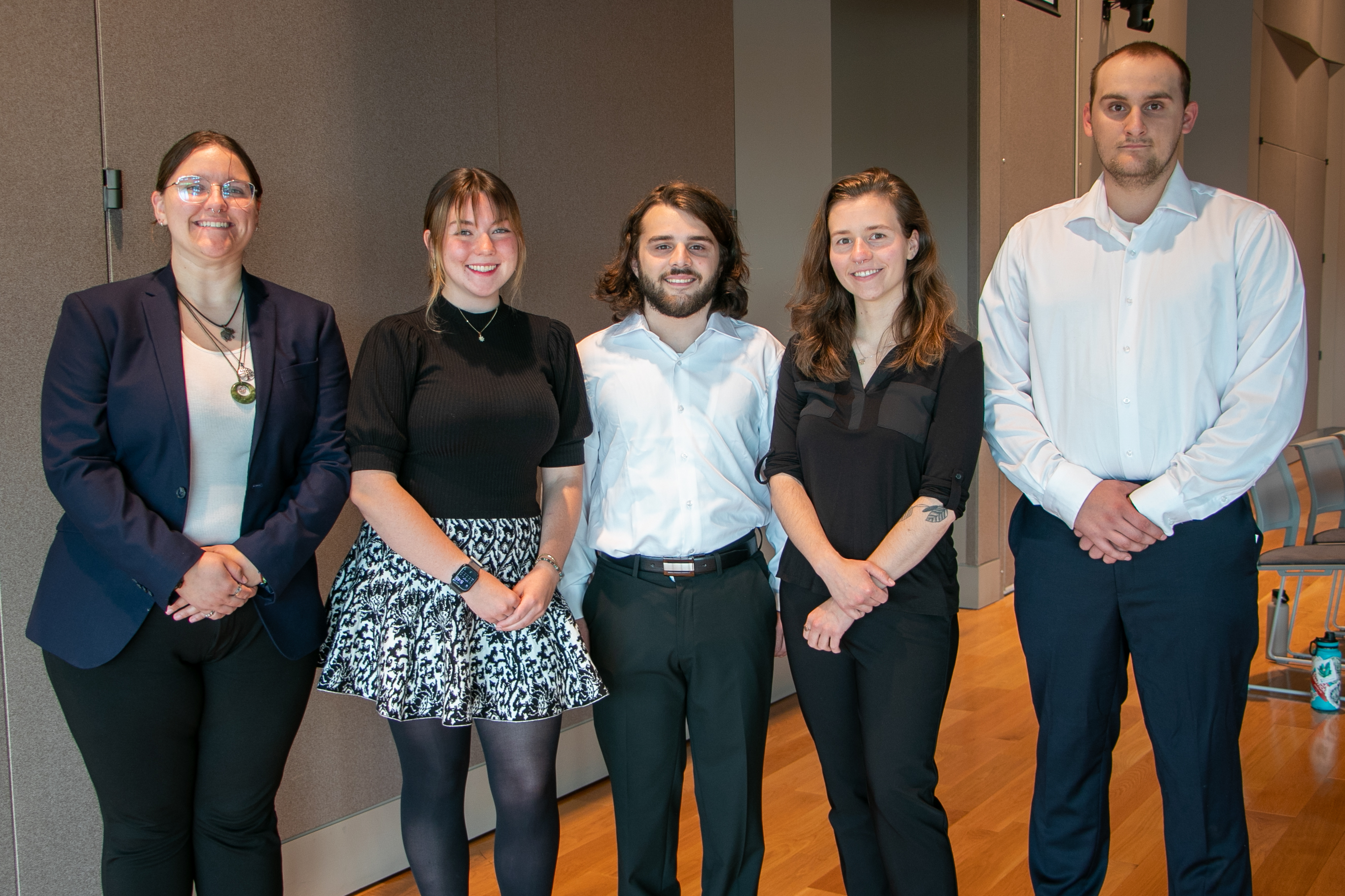
Photo by John Rudd
Five Garrett College Natural Resources & Wildlife Technology graduates and current students – left to right: Lauren Gooden, Ariella Malfaro, Alex Travia, Annie Martin, and Alex Hostutler – were the featured speakers at last Wednesday night’s Joan Crawford Lecture Series presentation.
A team of Garrett College graduates and current students discussed their 2025 summer employment, serving as the latest team of Natural Resources & Wildlife Technology (NRWT) students to work for the college as environmental technicians through a Maryland Department of Natural Resources grant. They discussed those experiences last Wednesday night in a Joan Crawford Lecture Series presentation entitled Getting to Know Wetlands: Our Summer Job Monitoring the Headwaters of the North Branch of the Potomac.
GC has been funded by a grant from the Maryland Department of Natural Resources’ Power Plant Research Project since Professor Emeritus Peter Skylstad – who attended the JCLS lecture – was first approached about performing work for the department in 2000. NRWT graduates Annie Martin (Class of 2024) and Alex Hostutler and Alexander Travia (both Class of 2025), along with current sophomores Lauren Gooden and Ariella Malfaro, were part of last summer’s crew. They monitored the continuing impact of acid mine drainage (AMD) and efforts to remediate the impacts from Mine No. 42, established by the Davis Coal and Coke Company in 1913.
"Mine No. 42 tapped into the richest coal vein in the upper Potomac," noted Gooden. "Shortly after opening in 1913, it was producing 250-300 tons of coal per day. Kempton, Maryland was the company town serving the mine and by 1918 had a population of 850."
Gooden said water began filling the mine in 1940. The company used a sump pump to remove the water until the mine was permanently shut down in 1950.
"The water pump ceased when the mining stopped," Gooden explained. "Water began discharging from an airshaft and an electrical borehole in the headwaters of Laurel Run, and the discharged water started flowing into the Laurel Run, severely degrading the stream and associated wetlands." According to Hostutler, "Laurel Run has the worst AMD in Maryland," and, prior to steps taken to abate it, was the most significant contributor of acidic water to the upper North Branch.
The long-term DNR grant has been used to study over time the impact of AMD on Laurel Run and other streams and wetlands. Travia said AMD is "formed when pyrite from the rock surrounding coal is exposed to air and water."
"It impacts soil quality and wildlife," added Travia. For instance, "AMD can leave behind residue made up of dissolved metals when they are oxidized by sulfuric acid."
"Our job was to monitor water quality, and detect, map, and monitor sources of acid mine drainage throughout Garrett County," said Martin. Particular emphasis was placed on keeping track of the AMD in the Laurel Run and North Branch wetlands, as well as watching for any evidence that water from the North Branch was being lost into the void mine space underneath the stream.
Hostutler said another key responsibility was identifying seeps, which might be sources of additional AMD, surrounding Laurel Run and North Branch wetlands.
Malfaro discussed the extensive biological monitoring that was conducted as part of the grant.
"Biological monitoring is a method for assessing the health of an ecosystem by analyzing the responses of living organisms to pollution and habitat change within a defined area," Malfaro explained.
Martin said the grant "has given a lot of student workers from the NRWT program the opportunity to gather and compile long-term data about the effects of acid mine drainage on these two wetlands."
"It has also provided opportunities to use GIS (geographic information systems) and GPS (global positioning system) skills – so essential to what we will do in our jobs," said Martin. "Peter [Skylstad] brought a GIS and GPS renaissance to the NRWT program. It’s a really useful skill – and cool we’ve gotten to use that in real-world situations."
The grant – supervised by NRWT Assistant Professor Amo Oliverio since Skylstad’s retirement – has provided nearly $700,000 in funding for approximately 75 student workers over the years.
Martin noted the grant also provides student workers with relevant experience in gathering water-quality data.
"It’s such a huge part of what we do," said Martin. "That helps us get experience in conducting various standardized surveys, and developing skills of problem solving and managing tasks, asking for help and working together as a team."