
Campus News
March 31st, 2026
Womb experiences have intergenerational impact
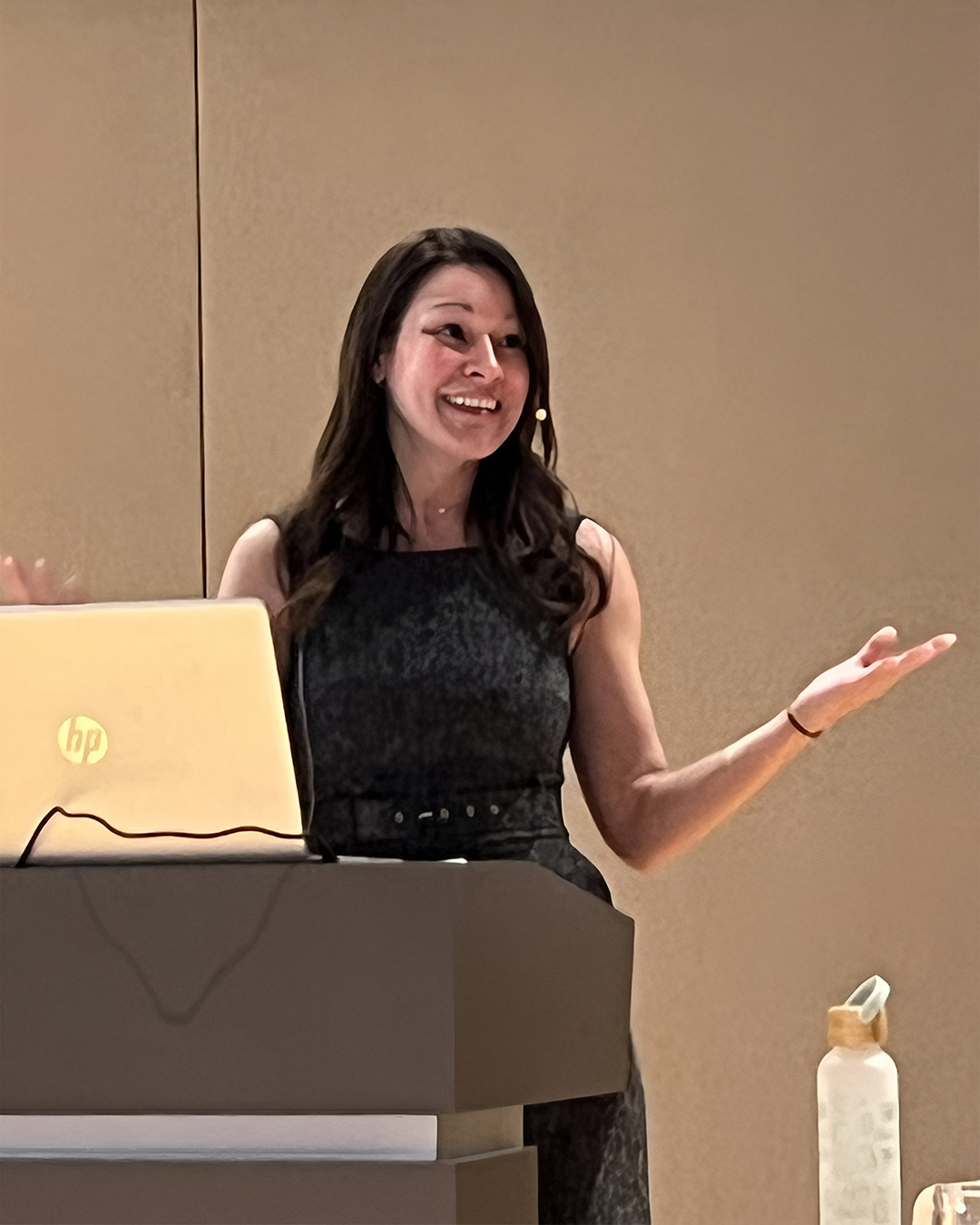
Mosser discusses recent significant research during JCLS presentation
Garrett College's Beitzel Career Technology Training Center held a workforce training open house last Thursday. Pictured, left to right, are Workforce Training Director Donna Bittinger, Academic Success Specialist Karen Linton, and CEWD Office Associate Brenda Murphy.
A baby's experiences don't begin at birth, Dr. Susie Mosser told those attending last Wednesday night's Joan Crawford Lecture Series at the Performing Arts Center at Garrett College.
"We know, in the womb, babies are doing a lot," observed Mosser, whose presentation was entitled Unlike Las Vegas, What Happens in the Womb Doesn't Always Stay in the Womb. "They're learning a ton, and they're even playing – they'll play with the umbilical cord. There's a lot of developmental things going on.
"They're even practicing eating already," added Mosser, who is serving as a visiting professor of psychology this academic year at Garrett College. "They have vernix – a protective, white, waxy layer covering their body. They're even picking some of that off, starting to eat it, and practicing swallowing."
Mosser also noted that the widely held belief that babies can hear while in the womb is entirely accurate.
"They've done studies in which they've put speakers up to the mom's belly playing Mozart, and they've done brain scans after the baby's born that show they recognize that compared to any other music," Mosser reported.
Mosser – who is a trained doula – said the first birth on which she assisted reinforced that point.
"As the baby's head is coming out... and the dad goes, 'Oh my gosh, my baby girl,' the baby's head turned toward the Dad," recalled Mosser.
"I said to the Dad, 'Did you talk to her [in the womb]? And he said, 'Every day.' And the Mom was like, 'It was so annoying,' " Mosser said with a laugh. "It was another indication that they really are absorbing so much in the womb."
Babies can have both positive and negative experiences in the womb – and Mosser said these experiences can impact a person for life.
"We often don't think about how stress can affect babies," Mosser observed. "There's been a lot of studies around women who were pregnant during major stressful moments - the Holocaust, the Dutch famine, the 9/11 attacks – that have been able to document the negative impact on these women's babies."
Mosser summarized impacts of stress in the womb, which can include cognitive and motor delays, preterm deliveries and low birth weight, anxiety, and depression.
"All kinds of things can happen because of stress in the womb," said Mosser.
"What I found in my research... is 'the baby's body bears the burden', " said Mosser. "What we have found is that even though we don't have language, verbal skills, as a fetus in utero, we still remember semantically – we have body sensations."
Mosser then shared an experience from a psychology conference she attended when a woman's symptoms were traced back to her own experience in the womb.
"This lady, who was pregnant, starting having PTSD-like symptoms and flashbacks – hearing bomb-like sounds, feeling like she was in a war," Mosser said. "I couldn't understand it; maybe it's hormonal, not quite sure, nothing was helping her. And, finally, I just said, 'Have you talked to your mom? Did she experience similar symptoms when she was pregnant?'
"She asked her mom and came back, and this will floor you," continued Mosser. "Her mom was in a war running from bomb shelter to bomb shelter while this woman was in utero. It didn't trigger the memories until she was pregnant with her first child."
Mosser also recounted the experience of one of her clients.
"She's like, 'I always feel like something's around my neck, I can't breathe, it just feels tight.' I said, 'Why don't you ask your mom?' " said Mosser.
"So what do you think she said when she came back the next week? 'I was a nuchal-cord baby,' " related Mosser, referring to a condition where the umbilical cord wraps around a baby's neck.
Mosser also discussed studies regarding the intergenerational impact of stress-inducing events, including an experiment where researchers trained mice to fear a cherry blossom-like scent by inducing slight electric shocks every time the smell wafted into their cages.
"Two generations later, guess what the grandpups were afraid of – the cherry blossom smell," Mosser reported.
"It isn't just mom and baby," Mosser said of the impact of the womb. "When your mom was a little fetus inside of your grandmother, you were already there. Females are born with all of the eggs they're ever going to have. Three generations in one."
There are many implications connected to this fact, according to Mosser.
"Looking at how we care for women and the womb. If you're an OB/GYN, if you're a social worker... you need to take care of pregnant women as the whole package," said Mosser. "You're not just helping her, you're helping multiple generations down the line, and into the future, which is super-important."
Mosser also emphasized that both stress and resilience can be passed on generationally and that "potential change, despite early adversity, is possible through neuroplasticity, epigenetics, and phenotypic plasticity." Neuroplasticity is the brain's ability to form and reorganize synaptic connections; epigenetics refers to how behaviors and environment can cause changes that affect the way an individual's genes work; and phenotypic plasticity allows for change and diversity in observable traits amid environmental pressures.
Notes: Mosser, a Southern Garrett High graduate, earned an Associate of Arts in social and behavioral sciences from Garrett College. She then completed a Bachelor of Arts in psychology from Point Park (PA) University, a Master of Science in Counseling Psychology from Chatham (PA) University, and a doctoral degree from Viridis Institute for Ecopsychology and Environmental Humanities.
A Licensed Professional Counselor (LPC) since 2011, Mosser has her own private practice in addition to counseling at other entities, including the Dove Center. Her private practice is for perinatal mood and anxiety, perinatal bereavement, and women's wellness.
Mosser is a published author in addition to being a practicing counselor and a college faculty member. Her books include Swimming in a Sea of Octopuses: Adapting to Increasing Speeds of Life, Peri Wrinkle – Smoothing out Perinatal Mood & Anxiety Disorders, and Because Life is so Bipolar.
She has another book scheduled for publication this year on transgenerational epigenetic transmission of intrauterine traumas. The book will focus on how psychological and physical stress, as well as environmental issues – including microplastics and other chemicals – can have lifelong impacts on a fetus.